



Strategic Investment in Smart Drug Delivery: A Key Opportunity for the Knowledge-Based Economy
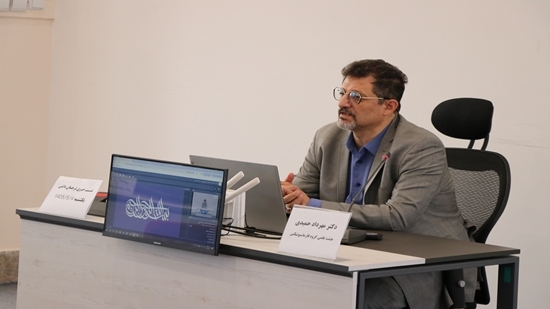
Dr. Mehrdad Hamidi, Vice-Chancellor for Research and Technology at Zanjan University of Medical Sciences and Professor of Pharmaceutics at the university, emphasized the need to move beyond the traditional pharmaceutical paradigm toward emerging technologies. He described the development of a national roadmap for smart drug development as a vital step for the future of treatment, stating that investment in smart drug delivery is a unique and strategic opportunity for accelerating the knowledge-based economy and significantly reducing the healthcare costs of the country.
On Sunday, August 25, at the “Tarjoman Danesh” press briefing, held with the حضور of media representatives, students, and interested attendees, Dr. Hamidi—who is also President of the Zanjan Health Technology Park and Head of the Pharmaceutical Sciences and Technologies Group at the National Science Foundation of Iran—explained in detail the national mission assigned to Zanjan University of Medical Sciences as the country’s scientific hub for pharmaceutical nanotechnology. He also highlighted the remarkable role of artificial intelligence, nanotechnology, and biotechnology in medicine, as well as the need to transform higher education in order to train interdisciplinary human resources.
The National Mission of Pharmaceutical Nanotechnology in Zanjan
Dr. Hamidi stated that the project to draft the national roadmap for smart drug development was a national assignment entrusted by the Ministry of Health and Medical Education to Zanjan University of Medical Sciences, as the country’s scientific hub for pharmaceutical nanotechnology with 13 years of experience. He said the project was completed through the active participation of nearly 200 experts and leading scholars from across the country over a period of one year and eight months of continuous research. The final report was submitted to the Ministry last month and was officially commended.
Emphasizing the concept of the “Impactful University,” which was introduced in Zanjan’s Research Vice-Chancellorship a year ago, he added that an impactful university must live within society, engage in dialogue with people, and respond to community needs, rather than merely publishing scientific papers. He said the roadmap for smart drug development was designed precisely in line with this social responsibility.
Why Are Today’s Drugs No Longer Sufficient for Treatment?
Raising a fundamental question about the need for smart drugs, the pharmaceutics professor identified four major challenges of conventional medicines. First, he said, many drugs are not selective and cause severe side effects. Current drugs affect diseased tissue but also damage healthy tissue. A clear example is chemotherapy, which may force physicians to reduce the dose because of serious harm to the bone marrow and gastrointestinal system, ultimately leading to treatment failure.
Dr. Hamidi added that the second issue is insufficient drug efficacy due to the inability to deliver the right amount of medicine to the target site at the right time. The third challenge is the worrying phenomenon of drug resistance, especially microbial resistance. Unfortunately, he said, Iran is among the top three countries in the world in this regard due to the excessive use of antibiotics. Finally, he pointed to patient fatigue and poor adherence to regular medication use, especially in chronic diseases and multi-dose regimens, as a major factor reducing treatment effectiveness.
Nanocarriers: Addressed Vehicles in the City of the Body
The Chancellor of Zanjan Health Technology Park compared the human body to a large city and described one of medicine’s long-standing dreams as delivering drugs directly to the address of the damaged cell without affecting other parts of the body. He said the main goal of smart drug delivery is the targeted and controlled transport of medicine in both time and space.According to him, smart nanocarriers function like vehicles that carry the drug and, through sensors installed on their surface, detect very subtle environmental changes such as pH, temperature shifts, or specific enzymes present in diseased cells—especially cancer cells—and release the drug precisely at the target site.He added that another smart strategy is the design of “inactive prodrugs.” In this method, the drug circulates harmlessly in the body and becomes active only when its chemical bond is broken by biological triggers in diseased tissue.
Disease Prediction by Artificial Intelligence Before Symptoms Appear, Using Weak Signals
Referring to the rapid development of artificial intelligence (AI), the Head of the Pharmaceutical Sciences and Technologies Group at the National Science Foundation of Iran stated that smartness in medicine means the ability to make timely, correct, and data-driven decisions. The human body generates billions of data points at every moment. By analyzing weak signals and picogram-level changes in blood biomarkers, AI can predict diseases such as cancer, Alzheimer’s, Parkinson’s, or multiple sclerosis months before the smallest clinical or visible symptoms appear.He said this represents a shift from “reactive medicine” to “preventive and proactive medicine,” a transformation that will reshape the healthcare landscape within the next five years.
The Era of Personalized Medicine and Digital Drugs
Dr. Hamidi described the future of pharmacy as moving beyond mass-production factories. He said that in the future, shelves filled with identical drugs in pharmacies will disappear. Medicine is moving toward “personalized medicine” and “precision medicine.” With technologies such as 3D printing of drugs and diagnostic kits, medication will be manufactured exactly according to the unique genetic and biological map of each patient at that very moment.He also introduced the remarkable concepts of “digital drugs” and “digital twins,” explaining that in digital drugs, communication with cells is no longer purely chemical but is based on the exchange of messages and digital signals. In addition, by simulating a patient’s digital twin, the drug response is first tested on the virtual model, and only after full confidence in efficacy and lack of side effects does actual treatment begin. In this new ecosystem, the boundaries between clinic, pharmacy, and hospital are integrated, forming an intelligent health management network.
The Need to Preserve Ethics and Human Wisdom in the Face of Machine Superintelligence
Expressing ethical and philosophical concern about the future of these technologies, the Vice-Chancellor for Research at Zanjan University of Medical Sciences warned that although the diagnostic accuracy of AI in analyzing medical images has now reached 97 percent and errors have been minimized, the major concern remains preserving human emotions, ethics, and privacy. He said humans must not become tools of machines.“We need harmony between human wisdom and artificial intelligence,” he said, “so that the human being remains the conductor of the orchestra and the machines serve as the players.”
A Warning for Higher Education: The Need for Interdisciplinary Training
Criticizing rigid and one-dimensional structures in the country’s education system, the faculty member at Zanjan University of Medical Sciences said the world is moving toward training multi-dimensional and interdisciplinary specialists, but unfortunately the higher education system in Iran still resists change and produces one-dimensional students. He stressed that the pharmacists, physicians, and engineers of Iran’s future must understand one another’s language as well as the language of data.“If we do not change the educational system from memorization-based learning to systemic and critical thinking,” he warned, “we will eventually become simple data-collection workers for the artificial intelligences of developed countries.”
A Call to the Governance System for Strategic Investment
Referring to Iran’s strong position in the fields of nanotechnology, biotechnology, and digital technologies, Dr. Hamidi emphasized that the country already has the necessary infrastructure and intellectual capacity. He said that the five-year action plan has already been submitted to the Ministry of Health as a roadmap, and now is the time to begin strategic investment in smart drug delivery so that the country can not only reduce the heavy financial burden of disease but also secure its rightful share in the global knowledge-based economy in this field.

Leave a comment